Clause 4 asks what your organisation is up against. A factor is one answer: an ageing machine, a single-source supplier, a regulation changing next year, a market opening up. Everything else in this module - the scores, the matrix, the year-on-year comparison - is built on this list.
Reading the analysis needs read_context_analysis. Adding and editing factors needs update_context_analysis.
One analysis per year
Factors belong to a year, not to the organisation in general. That is what makes the question "what changed since last year?" answerable, and it is the question an auditor asks.
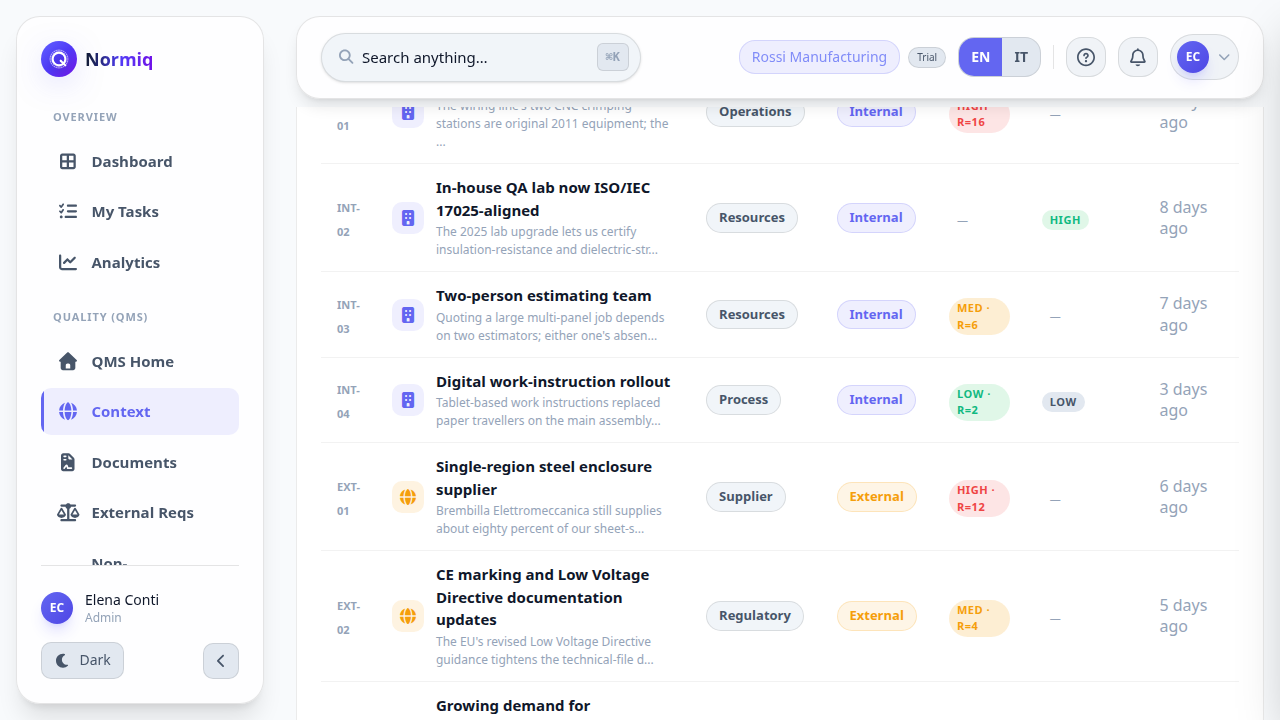
Open Context and pick the year you are working on.
Add an internal factor for something you control, an external one for something you do not.
Name it the way people in the business would say it out loud.
Give it an owner - a factor nobody owns gets reviewed by nobody.
What goes in a factor
The drawer holds everything about one factor: what it is, who owns it, its risk or opportunity assessment, the interested parties behind it and how it reaches the customer.
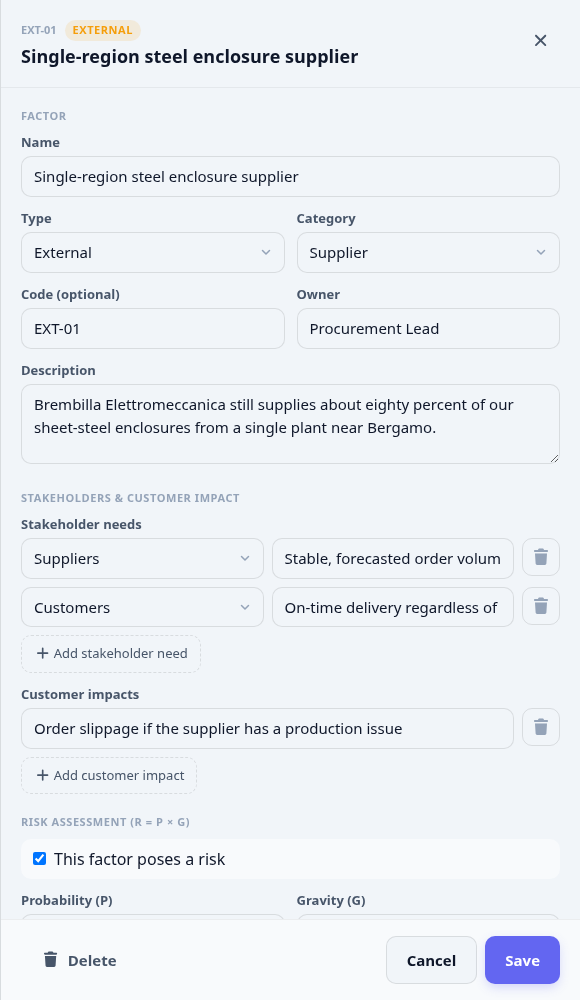
Write the description so it still makes sense next year. "Supplier issue" tells the next reader nothing; "eighty percent of enclosures come from one plant near Bergamo" tells them everything.